
Medically reviewed by Dr Ivan Schewitz, Cardiothoracic Surgeon (Heart, Lung & Chest Specialist). A specialist in cardiothoracic surgery since 1985, Dr Schewitz introduced the minimally invasive Nuss procedure to South Africa and has delivered more than 40 cardiothoracic presentations, several focused on pectus repair.
Pectus Clinic SA · Last updated August 2026
In short: Pectus carinatum, the protruding or “pigeon” chest, responds to external bracing in most growing children. When bracing is not enough, or when the patient has presented too late for it to work, the reverse Nuss procedure offers a minimally invasive surgical correction. A bar is placed in front of the breastbone through two small side incisions, applying steady pressure that reshapes the chest over roughly three years. No cartilage is removed.
For most young people with pectus carinatum, the first line of treatment is an external brace, and it works well. Steady, well-directed pressure on a still-growing chest reshapes the cartilage gradually and avoids surgery altogether.
But bracing has limits. It relies on flexible cartilage and on the patient wearing the brace consistently for many months. Patients who present in late adolescence, whose chests have already stiffened, or whose deformity is severe or asymmetric may not achieve an acceptable result with a brace alone. For these patients, the reverse Nuss procedure is the corrective option.
What the reverse Nuss procedure is
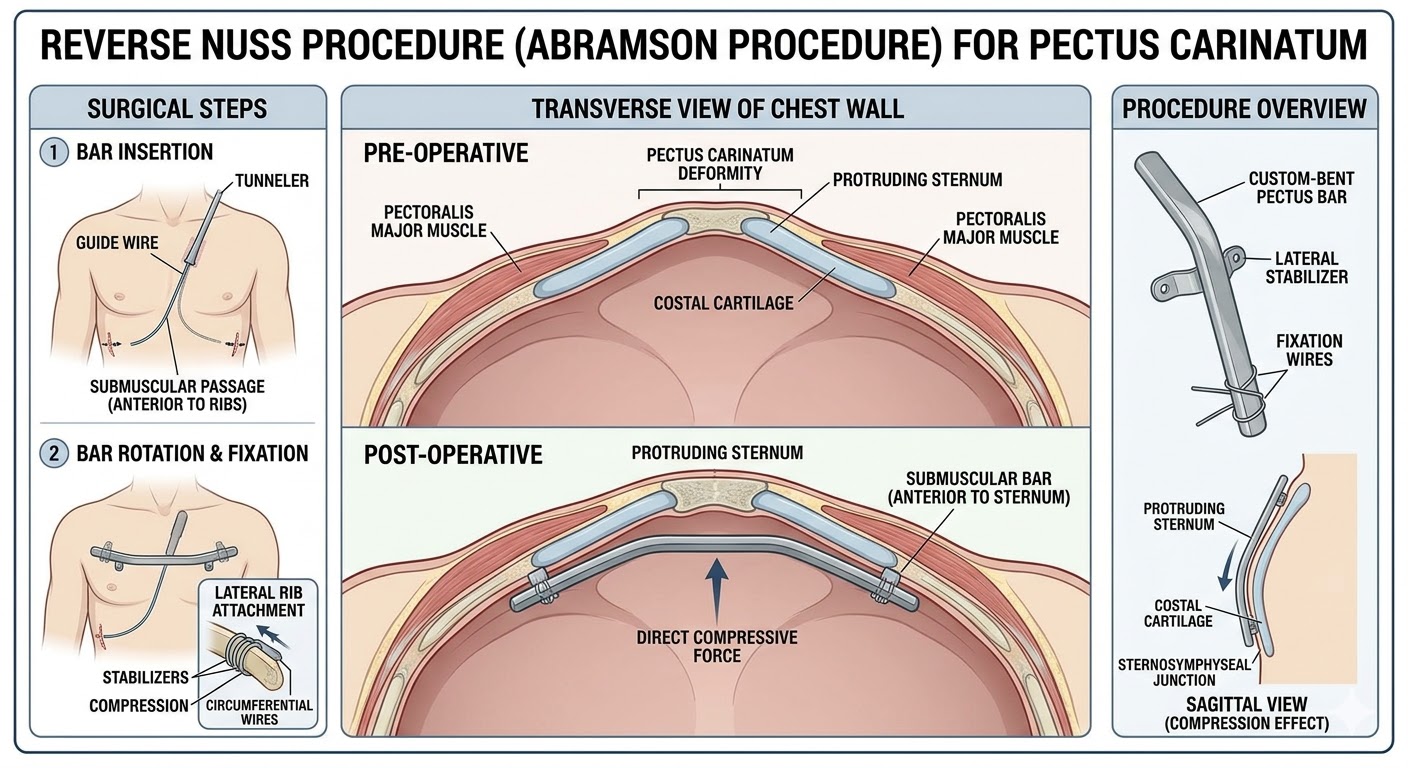
The reverse Nuss procedure, also known in the surgical literature as the Abramson procedure or minimally invasive repair of pectus carinatum, applies the logic of the Nuss procedure in the opposite direction.
The Nuss procedure treats pectus excavatum, the sunken chest, by placing a curved bar behind the sternum to push it forward. The reverse Nuss treats pectus carinatum, the protruding chest, by placing a bar in front of the sternum to press it back.
Two small incisions are made on the sides of the chest. A stainless steel bar is passed across the front of the deformed breastbone, running beneath the chest muscle but above the ribs, and fixed to stabilisers attached to the ribs on either side. The bar applies continuous, controlled pressure to the protruding segment. Over time, the sternum and cartilage remodel into a normal contour.
The bar stays in place for approximately three years, then is removed in a second, much smaller operation.
Why it matters that no cartilage is removed
The traditional surgical treatment for severe pectus carinatum was the Ravitch procedure, which involves an incision down the front of the chest and direct removal of the abnormal cartilage. It is effective, but it is a substantially bigger operation.
The reverse Nuss preserves the rib cartilage entirely and reshapes the sternum through sustained pressure instead. Published reviews of the technique report several consequent advantages over open repair: less blood loss, reduced postoperative pain, shorter hospital stay, and better cosmetic outcomes, because the scars sit laterally on the sides of the chest rather than down the middle.1,2
Aesthetic results in the published literature are strong. A systematic review of the Abramson method reported excellent or satisfactory cosmetic results in the large majority of patients both after bar placement and after the bar was later removed.1
Who is a candidate
The reverse Nuss is not the starting point for most patients. It is considered when one or more of the following applies.
- Severe pectus carinatum where bracing is unlikely to achieve adequate correction.
- A chest that has become too rigid for bracing to remodel, typically in older adolescents and adults.
- Asymmetric deformity that does not respond predictably to uniform external pressure.
- A completed or failed course of bracing that has left an unsatisfactory result.
- Significant psychological impact, which in pectus carinatum is frequently the primary reason for treatment, since the condition rarely restricts heart or lung function.
That last point deserves emphasis. Unlike pectus excavatum, which can compress the heart and limit exercise capacity, pectus carinatum pushes outward and seldom affects internal organs. What it affects is confidence. Avoided swimming lessons, refused beach outings, showering in a T-shirt, withdrawal from sport. These are legitimate clinical reasons to treat.
What surgery and recovery involve

Patients typically remain in hospital for around a week after the procedure for pain management and observation. Before discharge, pain medication is prescribed and wound care explained. A follow-up appointment usually takes place about two weeks later to confirm healing is progressing normally.
Breathing exercises form part of recovery for roughly the first six weeks and matter more than patients expect, because they maintain lung expansion while the chest is sore and movement is limited.
Strenuous activity is restricted during early recovery, and contact sports such as rugby and soccer are avoided until the surgeon gives clearance. The timeline is individual, but the principle is consistent: the bar needs an undisturbed period to settle and the chest needs time to begin remodelling before impact is reintroduced.
How it compares to the alternatives
External bracing remains the preferred first-line option for growing children with mild to moderate pectus carinatum. It is non-surgical, effective when started in time, and avoids anaesthesia entirely. If a patient is young, flexible and willing to commit to the wear schedule, bracing should be tried first.
The Ravitch procedure remains relevant for complex cases where the anatomy makes a front-lying bar unreliable, or where previous surgery has altered the chest wall.
The reverse Nuss occupies the middle ground: more definitive than bracing, considerably less invasive than open repair.
The importance of specialist assessment

Choosing between a brace and surgery is not a decision that can be made from a photograph. It depends on the severity and symmetry of the deformity, the flexibility of the chest wall, the patient’s age and remaining growth, previous treatment, and how much the condition is affecting daily life.
At Pectus Clinic SA, that assessment includes physical examination, imaging, and a discussion of realistic expectations for each available path. For patients outside Johannesburg, Cape Town and Durban, an online consultation is a practical first step.
The bottom line

Severe pectus carinatum that is beyond the reach of bracing does not have to mean a large open operation. The reverse Nuss procedure corrects the deformity through two small lateral incisions, preserves the rib cartilage, and produces reliably good cosmetic results. For the right patient, it is a well-established and comparatively gentle route to a normal chest contour.
Book an assessment at Pectus Clinic SA
Considering treatment for pectus carinatum, for yourself or your child? Request a specialist assessment with Dr Schewitz.
Medical disclaimer: This article is for general information only and is not a substitute for personalised medical advice. If you are concerned about pectus carinatum or any related symptoms, please consult a qualified specialist.
References
- Geraedts TCM, et al. Minimally invasive repair of pectus carinatum by the Abramson method: a systematic review. J Pediatr Surg. 2022.
- Janssen N, et al. Modification of the Abramson procedure for minimally invasive repair of pectus carinatum. J Thorac Dis.
- Abramson H, et al. Minimally invasive repair of pectus carinatum using the Abramson technique. MMCTS.