
Every year around May, our consultation rooms fill with the same conversation. A parent has decided that this is the year to address their child’s pectus excavatum or pectus carinatum, and the question on the table is no longer “should we?” but “when?” For the great majority of South African families, the answer turns out to be the same: winter school holidays.
It is not a coincidence. The four to six weeks following pectus surgery, particularly the Nuss procedure, ask a lot of a young patient: rest, careful movement, time off school, and a slow ramp back into normal activity. The winter break, running roughly from late June into mid-July, gives families a natural recovery runway that swallows the worst of the post-operative weeks without forcing a child to miss critical school time. If you are starting to think about timing now, here is what to plan around.
How long is pectus surgery recovery, really?
Pectus surgery recovery time depends on the procedure and the individual, but the broad shape is consistent.
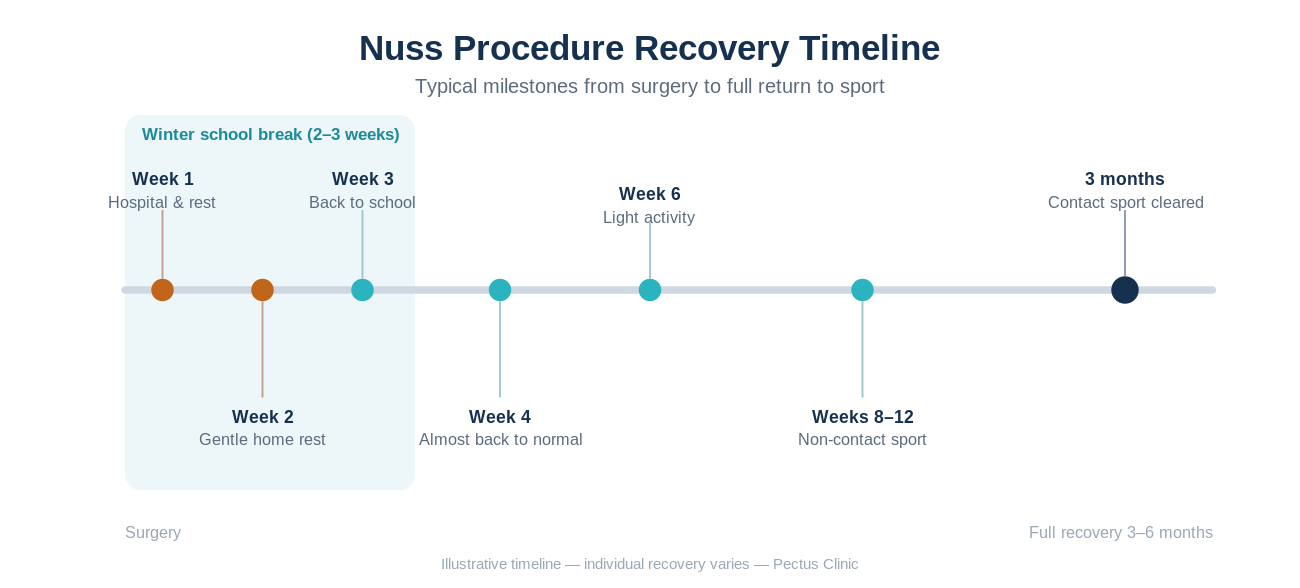
The Nuss procedure, the minimally invasive option used most often for pectus excavatum, involves a hospital stay of around four to six days for pain management, followed by two weeks of careful rest at home. By weeks three and four, most patients are walking comfortably, sitting upright at a desk, and ready to return to a school day. Light activity is allowed by week six. Contact sport, swimming galas, and rugby practice wait three months. Full recovery, where the chest feels entirely normal, is closer to three to six months.
The Ravitch procedure, used for more complex cases, has a slightly longer in-hospital stay and a slower ramp through the same milestones. External bracing for pectus carinatum, a non-surgical option, has no recovery window in the surgical sense, just a wear schedule.
When parents ask “when can my child get back to school?” the honest answer for the Nuss procedure is two to three weeks, which is exactly the length of the winter break.
Why South African families choose winter break
Three things line up neatly between the procedure and the calendar.
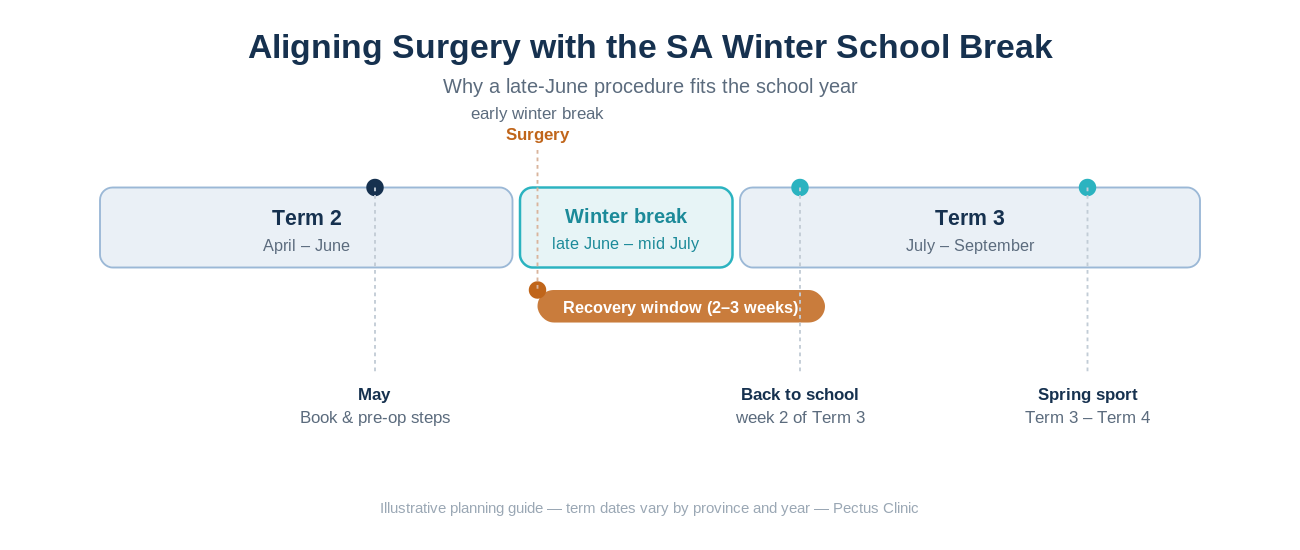
- The recovery window matches the holiday window. Two to three weeks of dedicated rest is precisely what a Nuss patient needs, and precisely what the June and July school holiday provides. A child who has surgery in the first day or two of the break can be back at school for the second week of the new term without missing class.
- Cooler weather supports recovery. Rest, low-grade activity, and avoiding excessive heat all favour winter. There is no swimming pool to be tempted by, no high-intensity training to skip, and the indoor pace of winter family life works in the patient’s favour.
- It clears the spring sport season. By the time term three brings athletics, swimming galas, and water polo back onto the calendar, a Nuss patient operated on in late June is well past the contact restriction and ready to participate.
For families travelling to Pectus Clinic from Cape Town, Durban, or further afield, the holiday window also means parents can take a single block of leave that covers consultation, surgery, and the first phase of recovery, rather than splitting it across multiple shorter trips.
What the recovery weeks actually look like
- The first week is hospital and home rest. Pain is managed first by epidural, then by oral medication. Most children are on their feet within forty-eight hours, walking short distances around the ward.
- The second week is gentle home life. Television, books, slow walks around the house and garden, careful sitting, and sleeping propped up on pillows. Bending, twisting, and lifting are off the table.
- The third week introduces structured movement. Short walks outside, gradual return to desk work, and the first day or two back at school for those who feel ready. School friends visiting is encouraged.
- By week four, most patients describe themselves as “almost back to normal,” with the bar settled and pain manageable on minimal medication. They are not yet cleared for sport, but the day-to-day rhythm of school, homework, and family life is restored.
Returning to school: what to expect
A child returning to school after the Nuss procedure typically needs three accommodations:
- They sit out PE for at least six weeks, sometimes eight.
- They avoid carrying heavy backpacks and tend to use a wheeled bag or a half-set of textbooks.
- They sit a little more carefully at their desk.
Most schools, when given a one-page letter from the surgeon, accommodate these requests without fuss. For older students writing matric or other major exams, surgery is usually scheduled to clear well before the September preparation phase. Term three is generally protected.
Sport and PE: the longer timeline
Light activity, including walking, swimming gently, and stationary cycling, returns at six weeks. Non-contact sport like cricket batting, golf, or jogging returns at eight to twelve weeks. Contact sport such as rugby, hockey, water polo, and martial arts waits a full three months, sometimes longer depending on the patient and the level of contact involved.
This is the timeline that most surprises parents, and it is the reason booking early matters. A Nuss procedure in late June clears a child for non-contact sport by late August and full contact by late September, just in time for term four. A procedure delayed to the September holidays would push contact-sport return into the new year.
Why May is the right time to start booking
Surgical theatre slots in the winter holiday window are limited, and they fill faster than most families expect. Confirming a date in May allows time for the standard sequence: an initial consultation either in person or online, imaging and the Haller Index measurement, cardiac and pulmonary testing, medical aid pre-authorisation, and theatre booking. None of those steps are slow on their own. Stacked together, with the demand of the holiday window, they take six to eight weeks comfortably.
Adults considering surgery can use the same logic, just adapted to work calendars. Many adult patients book around a two to three week leave period plus a phased return, and Pectus Clinic helps shape the calendar around what is sustainable for the patient’s professional life.
A note for families further afield
For patients flying into Johannesburg, Cape Town, or Durban from elsewhere in South Africa or southern Africa, online consultations make the early stages of the journey straightforward. Imaging and bloodwork can often be arranged closer to home, with the surgical visit timed around the holiday block. The clinic’s experience with travelling patients means accommodation guidance, post-operative follow-up plans, and remote check-ins are part of the standard package.
Booking the date
If pectus surgery is on the family agenda for 2026, May is the month the planning conversation needs to happen. Recovery aligns neatly with the school break, the winter weather supports rest, and the spring sport season gives a natural finishing line for the recovery process. The earlier the consultation, the more flexibility on theatre dates.
Related reading: Pectus excavatum and asthma-like symptoms – why cooler weather makes breathing harder.
Ready to plan a winter holiday surgical date? Book an in-person or online consultation with Dr. Schewitz and we will map the calendar with you, from first imaging through the day your child walks back into the classroom.